Sunday, November 14, 2021

That Keto Video

Dave Macleod's new, long video – does anyone call these vlogs anymore? - about keto diets for climbing came out a few days ago. I don't think it is much of a stretch to say that, among performance oriented rock climbers (climbing grade irrelevant), this was a highly anticipated video.  The video is four hours long and while training I watched it all (not in one session, four hours would be a mammoth and likely fairly useless gym session). Me, the person with the attention span of a gnat was fully engaged by a four hour video which is mostly Macleod talking with the odd climbing shot spliced in!


If you are interested in sports performance and your head won't explode if you have to confront ideas that challenge the status quo of sports nutrition, I recommend watching the entire four hours. People without a background in exercise physiology and nutritional science, might find the video a bit challenging. Around hour three I realised that Macleod was throwing around terms like mitochondrial density, which I understand, but which might be unfamiliar to many athletes. If “polarized training” makes you say “what?” you might need to take notes and look things up afterwards. There is no shame in that; one of the greatest free gifts of life is the ability to learn something new.

Thursday, November 11, 2021

Meatza Pizza

Well, I wrote that a surf capsize was coming right along and so it was. If you are going to capsize in surf, the only way to do it is by pitch-poling the kayak down a wave and flipping pointy end over pointy end. This is much more spectacular for random observers on the beach and you finish keel up, head down and ready to roll.


Today we finally got a day without rain so I dashed out bouldering. Broke a few holds, fell on my butt a few times, and generally got a decent session in before it started raining again. I've almost forgotten what our latest project looks like... maybe next week.


On the subject of weeks, last week when I was in Sydney, one of the youth commented on my vegetarian phase. I think of this period as a dark and low place in my history. It lasted two or three years from when I was maybe 25 or 26 to about 28 years old. Remaining a vegetarian - or even more hellish vegan - requires that you either lose your mind or get used to functioning at a low level of capacity. As I was happy with neither, I quit being a vegetarian, started eating meat and immediately trained harder, recovered better and improved my performance. I kept my brain functioning as well. Anthropologists and evolutionary biologists now think that a diet of meat is what led humans to develop such large and energy expensive brains. Think about that next time you consider giving up animal protein.


It always cracks me up that my sister in law (SIL) tells the story of me talking about being vegetarian while eating a ham sandwich. Now I don't actually remember the event, but I have heard the story so many times that it has become part of my personal lore, and, to give my SIL due credit, the story has a ring of truth. But, what really tickles me about this story is that it happened 30 years ago. Yes, as I said just last week “It was 30 years ago!” Emphasis very much intended.


In a twist of irony that is impossible to invent, I have been on a whole food diet – no sugar, no grains, no industrial seed oils – for at least five times as long as I was vegetarian and no one ever mentions that. I will let the reader ponder why that might possibly be.


Tuesday, November 9, 2021

Find What You Love

This is a bit of a stream of consciousness post because it has been so long since I published anything on the blog. I have had ideas – most notably the concept that, to paraphrase Steve Bechtel, “being average gives average results.” Bechtel fans will recognise this as a bastardisation of “random training produces random results.” But that is a topic worthy, at least in my mind, of fleshing out a bit more completely than this post has room for.


It is not that I have been doing too little to have anything to write about, more that I have been doing too much and have not had sufficient spare time to sit down and pen a long essay. Crazily, at almost 60, I still have the psych of a 26 year old when it comes to rock climbing so I have been exploring new bouldering areas and last Monday we ticked off another new climbing project and started the next one. That was also the day I looked down while I was belaying Doug and saw a one metre long snake on the rope bag about 4 centimetres from my bare foot. I am pretty sure humans have “snake recognition” wired into our evolutionary genes because I leapt up and back in under a second. Doug, who was working a hard sequence at the time, kept his cool remarkably well; reason number 76 for using a Gri-Gri or similar device to belay when your buddy is projecting.


Paddling is back on too. We've done a couple of surf days, during which I have surprised myself by NOT capsizing. I am almost starting to think I am improving but that might just be hubris. I'm sure another surf capsize is coming right along. I went out yesterday to do some surfing at one of our local beaches and within not very long broke a foot pedal which left me with a tedious paddle back home with no foot pegs to brace on and no rudder. It turns out that without foot pegs, you lose all torque (drive) and you end up “arm paddling.” It was tiring, inefficient and ineffective and gave me a good deal of insight into the speed and fatigue level of many of the people I paddle with who “arm paddle.”


Talking about broken gear, I finally got to Sydney last week to see my Mum who, thanks to Covid restrictions I have not seen since June. While there I managed to replace my worn out approach shoes and pick up a couple of other climbing items not available locally. “Not available locally” actually covers a lot of ground down here.


I am a shop assistants dream – I knew exactly what I wanted before I went in the store, so, apart from fetching the shoes from the back, I served myself and was in and out in a short time. There was an older guy there trying on every climbing helmet in the store for a canyoning trip he was going on. It was one of those situations where I thought, “yeah, you'll do this once, maybe twice.” Those sorts of things aren't hard to guess because the reality is most people do things a few times and then quit. I would love to have a single Bitcoin for the number of people I know who started rock climbing and gave it up within a year. I'd be as rich as Elon Musk, on the proviso that I could actually use Bitcoin for anything.


There was a bouldering route I really wanted to try in Jannali while I was in Sydney. I had been on it a few years ago but felt stronger and thought I might do way better, but the rain moved in on the afternoon I had set aside for bouldering and so I drove home instead.


Before heading up to Sydney I was getting pretty fatigued from another heavy training cycle combined with a lot of climbing and too many sprint kayak days. Sydney is always a good time to reset and take a deload week. I find being in the city, staying at other people's houses, living in a food desert, stressful enough without layering on heavy training. The noise, congestion, pollution are all a bit much when you are happiest deep in the bush.


But, the day after we got back, we were off paddling with Sprint A Lot (aka Splash A Lot or Speed A Lot) on a 25 kilometre paddle day. Sure, that does not sound like much but it was 12 or so kilometres into a 14 knot wind and building sea and then a serious sprint session to catch runners on the way back. Even Sprint A Lot was tired at the end. It was a super fun day out, with “interesting conditions” and we had a close encounter with a calf and mother Humpback Whale; but, when we pulled into the beach at the end I thought “so much for the deload week.”


One of my young relatives (by marriage) has signed up for another 70.3 (aka Half Ironman) with some mates. I asked if they were “competitive.” A reasonable question as for many people just finishing a race is the goal not placing in any sort of time category. Apparently, the youth are all competitive but as we were chatting about that I thought that we all assume that a concept such as “competitive” has a fixed definition. However, like most words, this is fallacy. The classic example of this is, of course, moderation.


What is competitive? To me, competitive means you will do lots of difficult and uncomfortable things to achieve your goal. More than just run, bike, swim training, I mean things like giving up alcohol and packaged food, eating more protein, cooking all your own meals, strength training, getting to bed early, correcting movement abnormalities, missing parties and social events to get your training in and on the list goes. Some of these are “add-ins” and some are “take aways.” Both are of equal difficulty and without a plan to succeed (that focuses on habit change), failure is more likely than success. As Dan John likes to point out, the root origin of passion is “to suffer.” If you are passionate about being competitive you will have to do things you don't want to do and stop doing things you do want to do.


As a fairly useless athlete, I've never really had the cojones to be competitive. Goal oriented absolutely, often to the exclusion of almost anything else, but not competitive. Strangely enough some of the people I know who are competitive perform strikingly worse than the people who aren't because although they want to compete, they don't seem to want to lose at competition and failure is the ultimate teacher.


Winston Churchill said “Success is stumbling from failure to failure with no loss of enthusiasm” which brings me full circle back to being stoked about every climbing session even though I have been pursuing the sport for decades. 

Find what you love and let it kill you. Charles Bukowski

Thursday, October 28, 2021

A Step Along The Ladder

In Episode 67 of The Sharp End podcast, while relating a scrambling accident that happened on Ellingwood Ridge on La Plata in Colorado, Tori, the protagonist or, depending on how you look at it, the victim, describes how she is "comfortable being uncomfortable." Apparently this is because Tori climbs in an indoor gym all the time. I see your eyes rolling and that is probably fair. There is little correlation between indoor rock climbing and scrambling a long, exposed and shockingly loose 4th to 5th class ridge on a 14,000 foot peak in Colorado and anyone who thinks they have become "comfortable being uncomfortable" is actually, as we all were at that age, simply blissfully unaware that we are - to quote Accidents in North American Mountaineering - "exceeding abilities."


Now that I am almost 60, I have to push myself hard to get into a situation where I might be "exceeding abilities." I know my abilities fairly well, although admittedly, I surprise myself sometimes by succeeding where I expected to fail. But knowing my abilities well, I seemingly can have all the will in the world to go out and do something challenging and yet achieve whatever the "thing" was without too much drama. Sure, I might be tired and uncomfortable and happy to have the "thing" (whatever it is) over, but generally I no longer reach out and touch the edge the way Tori did on Ellingwood Ridge.


In my youth, I fell over the edge - literally - many, many times. I fell down cliffs and knocked myself senseless, I staggered back from trips in the early hours of the morning by the faint light of a fading headlamp somehow expected to show up for work in two hours, I lost food on ski traverses and skied for days with nothing to eat, I endured mountaineering trips with all my gear including my sleeping bag soaked for half a week, on ski mountaineering trips my feet swelled to twice their size and had to be painfully stuffed into frozen ski boots every morning, I got hit by falling rocks, and caught in avalanches, I spilled out of whitewater boats in rapids and lost all my gear, almost drowned and had to bushwack out to the road carrying a whitewater boat with no paddle, I limped off rock climbs with sprained ankles, sustained countless scratches, cuts and bruises, dodged falling rocks on alpine climbs, shivered at belays, and disturbingly watched my gear rattle out of cracks leaving long unprotected sections of climbing. Twice, my climbing rope got caught in cracks and I had to untie and finish the route and once I was so scared leading a rock route (!) I almost blacked out.


Many, but not all of these mishaps occurred during the glory days of my youth when my adventure eyes were way larger than my adventure belly and I had the blithe over-confidence and hubris of youth that comes not from an honest estimation of difficulty and ability but just blind ignorance. If you survive that stage, eventually you learn to match your ability fairly closely to your challenge and you start having real fun, the kind of fun that challenges you just enough to push your boundaries out a little without scaring you spitless or shitless.


But, back to Tori and "getting comfortable being uncomfortable." Obviously, this is nonsense, one cannot be both comfortable and uncomfortable at the same time; a situation analogous to being both dead and alive at once. Even the Queen who easily could believe "six impossible things before breakfast" would not swallow that one.


Lately I have been thinking a lot about getting uncomfortable. Outdoor sports like ocean kayaking, rock and alpine climbing, ski mountaineering, whitewater paddling, backcountry skiing - the so called "adrenaline" sports - have drawn me since I was in my early twenties. The appeal is complex and involves a desire to explore both myself and the natural world as well as the need to get tired, scared, challenged, worked, and yes, uncomfortable.


I have wondered, however, if we are ever really are as uncomfortable as we think we are. Perhaps we have some kind of built in central governor mechanism that limits our choices so that when we head out to do something that scares or challenges us we unconsciously narrow down our adventure to match our ability. When young, we easily push out well beyond the boundaries of our expertise not because we are better at getting uncomfortable but simply through ignorance. As we gain experience, our ability to accurately gauge the balance between challenge and expertise improves and we settle onto a line that is close enough to, but not quite over the edge beyond which we would fail.


Sometime early in 2021, I don't remember the date but I do remember the place, Doug said that I was getting "fearful" as I got older. We had paddled out to North Head in an off-shore wind and had landed just inside North Head to consider our options. The wind was so strong that when we got out of our boats, the wind picked our boats up and it was only by quickly grabbing them that the boats were not tumbled and smashed on the rocks. I wanted to head back, Doug wanted to keep going. The problem with an off-shore wind is, of course, that it blows you off-shore, next stop New Zealand. We ended up paddling back. It was work, but not desperate, and I made the return journey with much less trouble than I had anticipated and I got to thinking that maybe Doug was right, I was getting fearful as I aged.


I like to think that since then I have regrown the ability to push against the boundaries again because I do not want to be a fearful person. Moving towards and beyond the edge of failure can be giddily intoxicating. Being scared to try and fail, yet trying and failing anyway, is perhaps one of the greatest gifts that adventure can impart. We learn that failure, rather than being a hard endpoint is actually a step along a ladder.

Wednesday, October 27, 2021

Programming For Kayaking And Climbing

 A good thing to remember when planning: if you get tired reading it, imagine what you are going to feel like doing it. Charlie Francis.

This could be the precis of my training log which I typically lay out a week in advance. It would be interesting to keep a paper log, because there would be a certain number of corrections that might be instructive in hindsight. As it is, my training log is a computer spreadsheet and if I switch around a paddle day with a climbing day or move a strength training day because I am not recovered that detail is overwritten and lost to analysis.


PC: N. Blacklock

I am back into training for kayaking while still training for climbing, which makes programming an exercise in creativity and frustration. As an older athlete, the dream of doubling up - two legitimate training sessions on one day - is just that, a dream. Recovery, particularly after hard efforts just takes so damn long, and trying to squeeze one more hard training or performance session in per week is so often counter-productive. Everything goes backwards and super-compensation rapidly becomes de-compensation. Ego checking at the door is mandatory.


Performance days sometimes yield surprising and unexpected results, like when you send a climb with no expectation of doing so or post a much faster than normal time on a regular aerobic training run. Our recent trip up Mount Donovan in Deua National Park involved 2200 metres of elevation gain in 1.5 days and most of that was bushwacking through rough and steep terrain carrying heavy packs. I felt pretty good the day after and finished the week up with a long climbing day, two paddle days - one all out sprinting - and a strength training session.


But then again, that could be why I am feeling a bit smashed this week and struggling to get through park bench workouts and modest climbing days. One thing about getting older, besides its inevitability, is recovery cannot be rushed, something that in the heady days of youth, climbing and skiing seven days a week, month after month, was simply unimaginable.

Monday, October 18, 2021

Getting Uncomfortable: Mount Donovan, Deau National Park

It is not exactly clear to me why I wanted to walk up Mount Donovan in Deua National Park. At just over 900 metres, it is not the highest peak in the park, fire roads go to higher mountains; but it is difficult to reach, particularly if you come from the east, and marks the northern extent of the Donovan fault line, a plug of old volcanic rock which has eroded into relatively sharp ridge-lines and deep cut gorges.


Away from the ubiquitous fire trails, most of Deua National Park is infrequently visited. The valleys are deep and steep sided, any trip off fire trails requires committed bushwacking, the ridge lines are waterless, while the creeks and rivers can be choked with vegetation that makes travel slow and difficult. Since the 2019/2020 fires, even the old bridle trails have disappeared under thick regrowth. Of course, in some weird way, all of that adds to the appeal as I am one of those increasingly rare people who simply enjoys the challenge. The problem with a comfortable life is that it becomes harder and harder to face physical and mental challenges. Eventually, we lose the will altogether.


Approaching from the east, there are three different, almost equally long, ridgelines that provide access to Mount Donovan; all originate at Oulla Creek so the first thing a walker has to do is access Oulla Creek. Fire trails run along the long north south running ridgeline to the east and provide a bushwack free approach to within a kilometre or so of Oulla Creek.


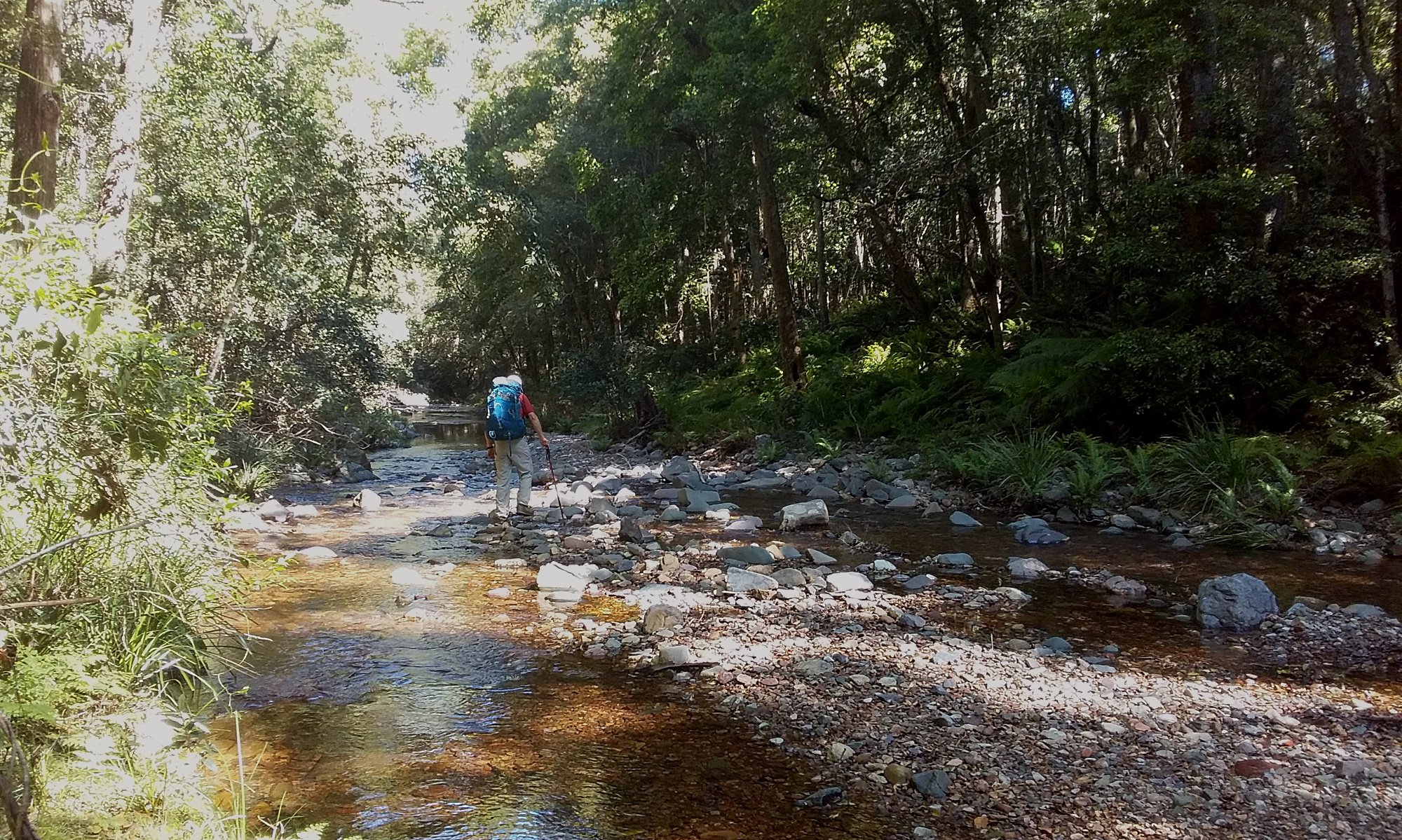
Leaving around noon, we had a couple of hours fire trail walking before dropping steeply into Oulla Creek where we found a wonderful camp-site in preserved rain-forest beside pools and small falls on Oulla Creek. After the obligatory mug of tea, I scrambled above Oulla Creek and down an old blind channel to rejoin Oulla Creek and the base of the ridge we would walk up next day. A mini reconnoitre to confirm our plan was not completely crazy.

I got up at first light the next morning and put the stove on for coffee. Doug followed shortly after and we had coffee and a quick breakfast and were away from camp at 7.15 am. We quickly crossed the ridge and descended back down to Oulla Creek and jumped across to the other side at a narrow gravel bar and started walking up.


We had a 400 metre climb up a spur ridge to join a prominent and narrow in parts ridge that runs along the south side of a deeply incised gully. The bush-wacking varied from quite easy to moderately difficult in sections where the ground was steep and loose, and the regrowth tangled in with burnt and fallen trees. At around 480 metres ASL (above sea level) we clambered up onto a narrow ridge of broken rock quite characteristic of the Donovan fault line. To the north was a deep rugged gully lined with bits of cliffs, also remnants of the Donovan fault line. To the east, we had views over the lowlands to the coast, while south lies the larger bulk of Deua National Park.


The next 1.5 kilometres of ridge was slow going although we gained very little elevation. Scrambling along the spine of the ridge was fun and almost reminiscent of mountaineering trips in Canada, except that there were twisted and twined trees and shrubs to push through. The views were spectacular, except that the top of Mount Donovan still appeared a disconcerting distance away.


After about two hours uphill, we scrambled off the narrow ridge and down to a saddle where we had a further 400 metres of uphill bushwacking to reach the top. There was definitely some very thick and slow travel through this section as last summers overgrowth of annuals had died back and lay thickly over the top of ankle twisting talus. Each step required a large high step to push down the dead vegetation matter and often it felt like we barely touched actual ground walking instead on matted dead vegetation. Finally, however, we intersected a north south running ridge and walked up open ground under large eucalypts to the trig at 906 metres. All around the ground falls away steeply and the top feels like an airy place to visit. A short distance down from the top we scrambled onto a big boulder with a view to the northwest for our first break of the day.


It was, however, a necessarily short break as we still had a long way to travel. As one always does after a long ascent, we looked for a "short cut" back to Oulla Creek, but, as is so often the case in the wilderness and life, there was no short cut, so getting back to camp involved retracing the route. Surprisingly, we did manage to shave about 40 minutes off our ascent time; often when bushwacking going down can be as slow as walking up. At 2:30 pm, we crossed Oulla Creek to our campsite, blackened by charcoal, scratched and torn, but pretty happy. I plunged into the chill Oulla Creek to wash off six hours of sweat and grime before pulling camp down while Doug brewed up a much deserved cup of tea.


We had a full hour at camp, although with taking down camp and packing backpacks, the actual rest time was considerably less. The least appealing part of the return trip was a 300 metre bushwack up through thick and tangled vegetation to regain the fire road. Doug thought this would take 1.5 hours given we were now hefting heavier packs and were somewhat fatigued already, plus, this last section of bush-wacking was some of the most tangled and tedious we did over the entire trip. However, one hour after leaving camp I regained the fire trail at exactly the spot we had left it a day and a half ago, despite having sweated profusely on the way up as the weather changed and the humidity increased. A couple of hours fire trail walking, one more river ford, and we were back at the car, tired, grubby, happy.

Wednesday, October 13, 2021

Barely Better Than Nothing

Diabetes Australia just published their position statement on type 2 diabetes remission. Recognising that a lifestyle disease can be improved or even reversed with lifestyle interventions seems self-evident but has, in fact, been anything but blindingly obvious except to a few fringe dwelling lunatics who believe mainstream medical advice to eat a "healthy diet high in wholemeal grains" and "all foods can fit" is complete tripe.

If you take the time to read through the position statement you will conclude, at least fringe dwelling lunatics will conclude, that the position statement is better than nothing, but not by much. Firstly, this phrase "Healthy eating (with attention to portion size and kilojoule intake)" sounds suspiciously like "eat less, move more" to lose weight. While that strategy may involve weight loss, how does one actually eat less and move more? If the equation were so simple we would not have a diabesity problem that is currently far worse than any infectious pandemic.

But, back to "healthy eating." What is healthy eating? Who knows, there is glaringly no definition. Similarly, "portion control and kilojoule intake" is a failed strategy. We now have literally decades of advice from conventional medical practitioners to pay "attention to portion size and kilojoule intake" and the result is a population that is sicker, fatter and weaker at every age group. There is a point at which even the "experts" have to come around to the idea that "insanity is doing the same thing over and over, and expecting different results."


What is surprising - or maybe it isn't - about this position statement is that the real drivers of type 2 diabetes remain completely ignored. Sure there is the standard "genetics, age, lifestyle factors including food intake and physical activity, weight, use of some medicines, and other medical conditions" (which came first the insulin resistance and diabetes or the other medical conditions?) to explain type 2 diabetes but none of these explain the rapid and disastrous increase of type 2 diabetes over the last several decades. Our genetics have not changed, our physical and social environment has.


Here is a short list of the things that really lead to type 2 diabetes:

  • An over abundance of cheap, readily available addictive processed and highly processed food.

  • "All foods can fit," aka "moderation", "portion control" and other such platitudes.

  • Protein dilution in the modern diet.

  • Poor dietary guidelines which, if followed, minimise protein intake.

  • Ignoring the protein leverage hypothesis and maximum foraging strategy as evolutionary drivers of food intake.

  • A societal trend towards rewarding every event with food.

  • Eating as recreation.

  • An environment which favours little movement and maximal calorie intake.

  • The addition of industrial seed oils and sugar (in various forms) into every packaged food in the supermarkets and all cafe, restaurant, and take out meals.

  • Lack of social support for people who want to eat a real food diet.

Overall, the tone of the position statement is negative and realistically, I think, represents the reality of achieving diabetes remission in our current environment. Giving up processed and ultra-processed food is, in fact, very hard and goes against both evolutionary drivers that control our behaviour and social norms. I know this personally, yet I consider myself lucky to have a partner who is both supportive and who shares my lunatic, fringe dwelling beliefs. People with less conviction, less grit, less social support, even less understanding of how our brains actually work, are literally standing against Big Food, Big Pharma and Big Medicine like David battling Goliath.

There are three words missing from this position statement that doom it to failure by the time the sun sets this evening and those are "whole food diet."