Tuesday, September 5, 2023

Following Spring Creek

There’s a Spring Creek Fire Trail (FT) but no creek named “Spring Creek” on either the standard topographic map or Six Maps NSW, but, it’s easy enough to work out which creek the FT is named for as the FT crosses the upper reaches of the creek a number of times. Spring Creek runs into Nelligen Creek which runs into the Clyde River. I’ve been along Spring Creek FT before when I was doing a lot of trail running. That time, I followed Spring Creek FT all the way down to where it crosses Cabbage Tree Creek in Monga National Park. It’s a hilly FT and fairly eroded and somewhat slippery after heavy rain followed by lots of dry weather. I’ve also been down along the banks of Nelligen Creek on a couple of occasions most notably when I trashed all my clothes trying to bushwack up Erics Ridge.


Why would I be back in this area when I had all but sworn off bushwacking until the fire regrowth dies out? Well, I had seen some recent photos online of a group walking along Spring Creek and the trip looked quite reasonable and reasonably interesting. A short drive for me, a FT approach, and some rocks to scramble over.


Here’s the thing, I went down the eastern tributary of Spring Creek and I believe now that the images are from the western tributary of Spring Creek. I had planned, or at least thought about, descending the eastern tributary and following this roughly SW to where both branches of Spring Creek join and then regaining the FT by following the western tributary roughly north.


The eastern tributary had a small amount of water in it and is the first crossing of Spring Creek you reach as you walk along Spring Creek FT. Following the creek was reasonably easy and reasonably pleasant. In places it was easy to walk along granite slabs in the creek – the water level is really low right now-, although the water-washed slabs were surprisingly slippery. Some places, however, were choked with large piles of flood debris indicating that even this little creek has significant flow at times. It was, however, quite easy to follow game trails along the left hand (eastern) bank when required.
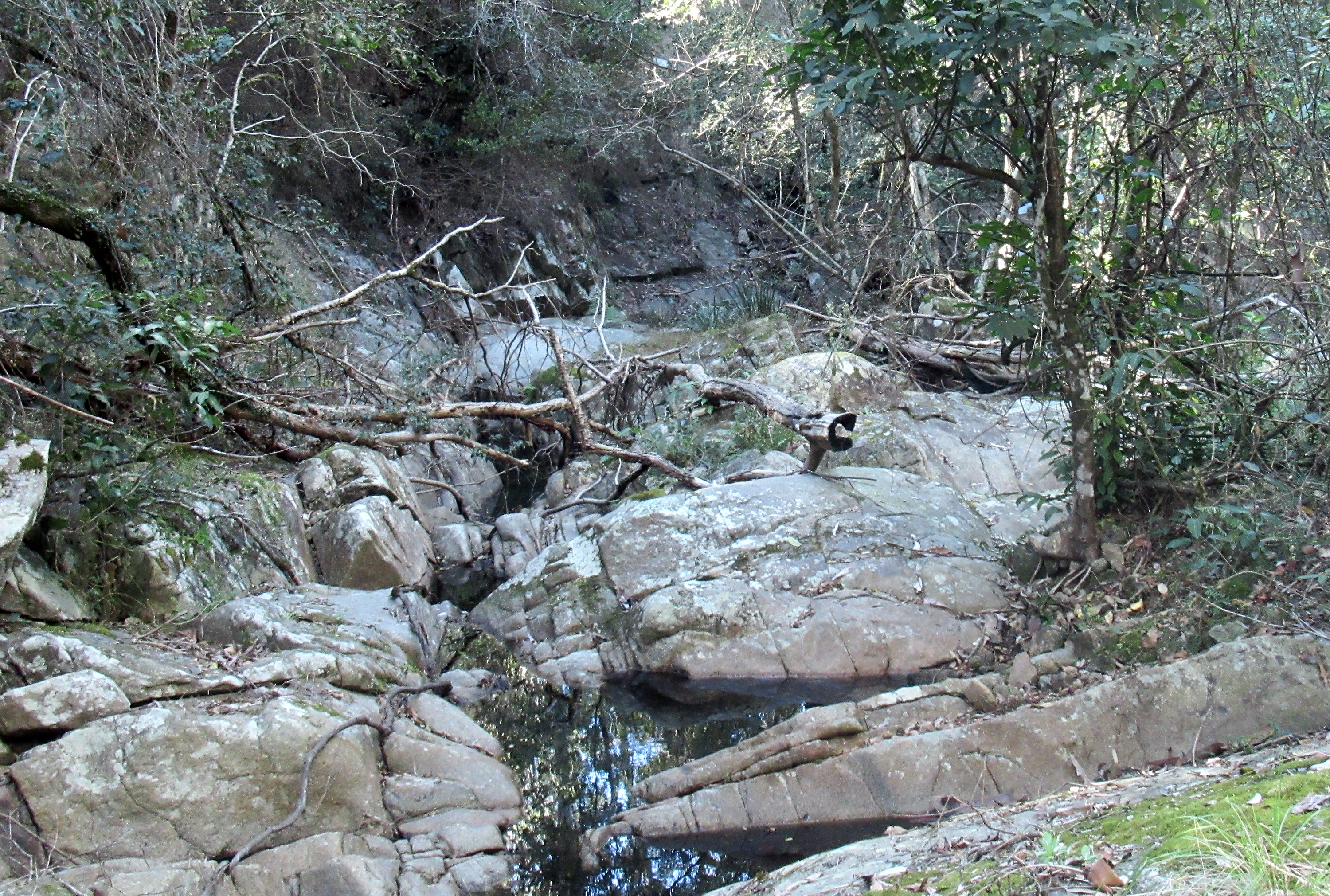


After a while, I came upon a large grassy flat area near the creek, a good spot to pitch a tent, and the confluence with the western tributary. I followed the western tributary north for a while but the bush in this smaller drainage was very thick, and the going not pleasant at all. Looking at Google Earth more closely, I think the big slabs in the images are in the upper reaches of this western tributary not down near the confluence. As I had already passed a number of large and healthy Stinging trees on the more open eastern tributary I was not keen to potentially encounter more of them in the thick bush of the western tributary; and, of course, there is only so much thick bushwacking I have patience for.


I decided I would exit via Nelligen Creek FT (I’ve been on this FT before too) and thus had an easy time of it walking uphill through quite open forest even finding a very faint old vehicle pad which sped up progress. The denouement was a simple walk up and over a 220 metre high point on Nelligen Creek FT to its junction with Spring Creek FT and all the little hills back to the car.


Sunday, September 3, 2023

The Day We Went Missing

Trigger warning: Readers may disagree with the opinions expressed below and may also believe me to be deplorable (remember Hilary Clinton’s “deplorables” moment?), morally bankrupt, selfish, egotistical, and generally a thoroughly reprehensible person.

It had to happen, or maybe it didn’t; maybe if Australians were not so obsessed with safety, rules, regulations, general wonkism, no-one would have blinked an eye, but this is Australia in 2023 and the pioneering instinct to push boundaries has well and truly shrunk to a daring exploit being defined as visiting a grocery store while not wearing a mask.


Our car, parked at Clairview boat ramp to await our return after a two week sea kayak trip was reported to the police and we were tracked down to a remote island and our neighbours, back home on the south coast of NSW interviewed about our whereabouts. All this because we did what we always do: we parked our car at the planned terminus of our two week sea kayaking trip and paddled happily off-shore in search of the real world.


Once, and I cannot remember when that time was, we did report to the local police that we were leaving a car parked. My recollection is hazy but I think it was a small town somewhere in Northern Queensland and we were leaving the car on the street so we left some information with the local police service. Otherwise, we don’t randomly walk up to strangers, even strangers that live close to where we are leaving the car to say “Hey, that car there will be sitting unattended for two weeks, have at it.” That seems like a bad idea. But perhaps, after our recent experience, I will change my mind. Certainly in future, we will report our parked car to police. At least if police are alerted by hypervigilant members of the public they have no requirement to waste their time chasing down people who are on holiday! Lesson learned.

The irony, of course, is that we always lodge a trip plan with at least one, and generally multiple “responsible” people with instructions on what to do should we not return on time. We all carry PLB’s, radios, and mobile telephones and our trip plans are assiduously constructed to mitigate risk. No-one survives 40 years of outdoor adventuring without doing these things.


When we got back home, I went over to chat with my neighbour, elderly, delightful, Italian in that stereotypical Italian way (that is NOT racism). “I pray to God,” she repeated several times while waving her arms in the air, “I pray to God, that you are alive.” I apologized profusely, as profusely as Doug apologized to the police when we got back in range of mobile service and were able to pick up our messages.


The real moral of the story however, may be the level of survellance inflicted on the general public. Did we actually agree to this, or has the culture of safetyism simply enabled the expansion of surveillance under the guise of “keeping us safe” – a truly cringe worthy approprism? Like online tracking, most people seem supremely unconcerned about being monitored by various automatic cameras with recognition technology, somehow believing that the Zuckerberg’s and Xi Jinping’s of the world have beneficent instead of malevolent intentions. One would think the pandemic years would have disabused folks of these notions, but, I guess if you tend towards extreme paternalism such surveillance may be comforting.

Wednesday, August 9, 2023

Don't Be Weak

Endurance, from the root endure, is an old word, from the 14th century when endure meant “to undergo or suffer,” or “to continue in existance.” It’s interesting then that some folks think that endurance can be developed from short high intensity activities. From an etymological perspective this makes little sense, and possibly even less from a sports science perspective. Physiologically and metabolically, developing endurance does require the protypical long, slow distance effort.

Ideally, one follows a well designed training programme during which endurance both metabolic and physical is slowly built upon. This certainly reduces the suffering that one must tolerate as endurance is built, but, as with any effort to force supercompensation, some discomfort is natural.


We logged another 30 kilometres of paddling on Monday, this time all on the open sea. A light headwind and a sagging swell meant that I got a wee bit sea sick once we’d passed Burrewarra Point, but the queasiness of mild sea sickness is also something that a sea kayaker needs to learn to endure. Mostly I felt cramped for the last few kilometres and noticed that my already not very good paddle stroke quickly deteriorated without intense concentration.

Saturday I ran around the Dam Loop which from my place is just over 15 kilometres – with a decent (for a flat country) amount of elevation gain (440 metres) and an enjoyable forest bathing experience. I stuck to nose breathing pace (aka ventilatory threshold – VT – one) as the two preceding training days had been tough – 30 kilometres paddling, heavy strength. Nose breathing pace felt right and more importantly I would recover more quickly.


How useful is endurance? Consider this news story. Imagine if all the people at the top gondola station had even a modicum of endurance they could have walked back down the (very well maintained and groomed) track and been back in their hotel rooms in time for a nightcap. After all, the track is only 10 kilometres long and is all downhill. My Mum walked further on a rougher track when she was 80.


Thursday, August 3, 2023

The Power Of Numbers

I don’t know if the planet is really boiling but down in my part of the world we are having a warm, dry and largely benign – as far as sea conditions go – winter. On Tuesday, Margot got the band back together and we had eight paddlers out for an easy paddle on a “summer” winters day. There’s no doubt the band is getting older and a couple of people are facing serious medical illnesses, so each day with friends in a free and beautiful part of the world feels like the ubiquitous #blessing, except, I think #blessings are out now and #victim is in.


Our paddle total on Tuesday, however, was only 18 kilometres, two kilometres shy of our self-imposed 20 kilometre minimum target. Thursday, on an even warmer day with northerly winds, we set out to paddle 30 kilometres. For some reason, unknown to myself, I had decided I wanted to walk at least 8 kilometres (5 miles) every day for a week, so before paddling I went out at dawn to get the 8 kilometres done.


The northerly wind was a bother and, combined with the sea current running south, made progress north up the Murramarang Coast slow. We did 8 kilometres and then turned around and made up the final 22 kilometres paddling around the northern side of Batemans Bay as far as the new bridge over the Clyde River. Finally, with 24 kilometres on the clock, we could catch the tidal current and paddle back home. At our home bay, my odometer had not quite cracked 30 kilometres so I paddled out to sea far enough to watch it tick over, then back.


Now the real dilemna becomes obvious, stop at 38.5 km (30.5 km paddling and 8 km walking) or bump that number up to 40, an appealing number, divisible by ten – the basis of our decimal system. Bump to 40 is the obvious and only number. Luckily, trolleying the kayak home and a bit more walking and I was able to call Thursday a 40 kilometre day.


Wednesday, July 26, 2023

Paddling Up A River

It’s been a long time since I have had a “day after leg day” like yesterday. My last six week training cycle was almost all body weight training - think old school calisthenics - four sets of six reps of the fundamental human movements (push, pull, hinge, squat) mostly body weight but some accessory training with weights. Four different workouts repeated weekly for six weeks, which is very close to a Dan John style “Easy Strength” program. I am now on a short two week cycle of heavy strength and power, one day of each per week for two weeks.


Dan John, and many others, have found that easy strength training works, probably by leveraging the little and often principle which reduces fatigue while increasing skill and allows for more frequent training in the long run. Easy strength is great, but there is still a need to push harder on occasion with those workouts that some call “break-through” and others (Dan John) think of as “Bus Bench.” Monday was a Bus Bench day and it was gratifying to add weight to the bar and realise that the calisthenic “Park Bench” sessions did exactly as designed, increased capacity without too much fatigue and muscle soreness.


Tuesday, however, was certainly a “day after leg day” kind of day. I needed to get in a paddle training session but wanted to break the day up with some perambulation midway. I’m not necessarily super happy about leaving my kayak and kit on an easily accessible beach while I walk for an hour or two, so I decided I would paddle up the Clyde River where I could stash the kayak in the bush out of sight and hike uphill for a bit instead.


The best trip I’ve done like this up the Clyde River is the Sunday we paddled up to the Buckenbowra River and hiked up Sugarloaf Hill. This time I planned to paddle a slightly shorter distance up Mundarlow Creek and possibly end up somewhere near the inexplicably named “Humbug Gully.” Paddling the Clyde River for sea kayak training is really cheating a bit. I endeavour to do all my training paddles on the ocean. I don’t think sheltered river or lake paddling translates all that well to paddling on the open ocean exposed to the unpredictable mix of wind, swell, and sea. However, this is the first, and will be the last, of my training paddles on the river, so perhaps I can be excused this once. Or not, I’m okay with being called out.


On a winter’s morning, it is common for a westerly wind to drain out the Clyde River valley but I had the tide with me paddling from my home bay, across the Batemans Bay bar (no drama today) and up the river. In the winter, midweek the Clyde River really is a peaceful place, reflections on the water, fish jumping, herons and pelicans among the oyster farms. It took a bit of paddling about to find a spot to land up Mundarlow Creek. It was about half tide and the shore was mostly knee deep (literally as I discovered) in sucking mud with clumps of oysters interspersed. Just as I was about to give up I found the terminus of an old fire trail with solid ground and I was able to land and heft the kayak up into the scrub.


The overgrown fire trail took me up to the Runnyford Road – a high quality gravel road – in a half an hour with the usual face slapping from post-fire regrowth. The Runnyford Road was dusty and dry, unappealing in a different way to regrowth, so I turned around. Back at the River, I drank tea, thought about how good it would be to have lunch with me, and enjoyed the peace of this backwater of the Clyde River on a sunny winter’s day.


There’s always a head wind on the Clyde River no matter which way you paddle. The tide up Mundarlow Creek seemed to be at stasis point so I expected to have the current with me once I paddled back to the main Clyde River, but, alas, the tide was still running west up the Clyde River. So I had both the wind and the tide in the wrong direction – or right from a training perspective - back out to Batemans Bay. Perhaps such an occurrence makes up for paddling on the river not the ocean.

Thursday, July 20, 2023

Objective Standards

It’s not the best of times or the worst of times, it’s the strangest of times. A friend of mine, currently heavily involved with the health care system as a consumer, related her experience with one of her ancillary health care providers recently. Ancillary providers, for those lucky enough NOT to be ongoing and active consumers of health care are professionals like exercise physiologists, podiatrists, physiotherapists, psychotherapists, and counsellors. This ancillary health care provider was well indoctrinated into the concept of “patient centred care” and asked my friend what her goals for therapy were. Which sounds really reasonable. Much like a “Voice to Parliament” or “gender affirming care.” Intuitively, it makes sense that better outcomes will prevail if the “consumers” of care choose their own goals. But is intuition right?


As firmly entrenched as society is now in what some call “the post truth era” and others think of as simply delusional, it seems archaic to think that objective standards might result in better outcomes than the pursuit of insubstantial and shifting personal goals. Certainly for my friend, some relevant objective standards such as “can walk one kilometre unaided in 20 minutes,” “is able to get up and down off the floor without assistance,” “can carry two loaded grocery bags for ten minutes” are suitable standards, the attainment of which indicates a capacity for independent living versus dependency. Most people, even those who aren’t quite sure what a woman is, might recognise that the achievement of objective standards such as those described above is a positive outcome.


Ironically, the societal advancement that we all appreciate – from medical care to smart phones – which we accrued using objectively verified evidence – also known as “science” – has now become axiomatically false. An agenda driven by the Critical Theorists but enthusiastically embraced by a vocal, powerful and ever increasing segment of society. I’ll believe it’s all a good idea when the Critical Theorists give up all the accoutrements of our modern society achieved through science. Until then, I am going to hold onto objective standards.

Tuesday, July 18, 2023

Did I Get Better Today?

Years after hearing Dan John say “The goal is to keep the goal, the goal,” I think I have finally understood what this pithy and much misunderstood expression means. Beyond not getting side tracked by diversions along the path, keeping the goal the goal means that your actions, all your actions are congruent with your stated goals. A statement that seems so simple but in reality encompasses everything we do, and imagine, and think about in life.


It appears that the easiest way to misplace the goal is to default to instinctive behaviours – particularly those we use to ameliorate stress – which are frequently orthogonal to keeping the goal, the goal. I am as guilty of this as anyone. I think some sort of meditative practice, whether it be strict meditation as classically described or a moving meditation such as long runs or walks in nature, is a helpful adjunct to keeping the goal the goal as such practices give our minds space to confront our reflexive nature and, at a minimum, consider if our predominant behavior is actually congruent with our stated goals.


An easy first step to keeping the goal the goal that I have implemented is simply asking “does this choice align with my ultimate goal?” Dan John, of course, has a more impactful way of communicating this “Did I get better today?”


In more prosaic news, I am experimenting with increasing the effort on my regular zone 2 training runs/walks. Peter Attia uses an RPE (rate of perceived exertion) slightly higher than I generally use for my zone two training. I typically use the top end of my ability to nose breathe, while Attia uses conversational pace where conversation is possible but verging on difficult. Coincidentally, the latter RPE for me is right around a heart rate (HR) of 120 which is also my MAF (Maximum Aerobic Function) HR. I lapped around the Dam Loop today at an average HR of 120 and felt like I could keep going forever (except for sore feet as the dry weather is making the trails extra rocky) which is pretty much how zone two training should feel.


Sunrise pictures from yesterdays aerobic conditioning session.