The regular Sunday paddles were
interrupted by a weekend gathering at Honeymoon Bay on the Beecroft
Peninsula. It was a small group, only 10 paddlers and the forecast
weather was reasonable, but not completely conducive to paddling into
the caves that tunnel deep into the sandstone cliffs of the two major
peninsulas on either side of Jervis Bay.
I am one of those tedious goal oriented individuals who always arrives with a goal and a
multiple stage plan to arrive at that goal. So, I arrived at the
Friday night "lets talk about the plans for tomorrow"
session with a clear objective: find someone, anyone, who wanted to
paddle south to Bowen Island on Saturday, and, on Sunday, when the
swell was forecast to drop from two metres to one metre, paddle the
iconic circuit of Beecroft Peninsula which is, or should be, on every
sea kayakers to do list.
Well, the talk went round and round
and, in an ironic twist which would later become absurd, half the
group voted to do the Beecroft circuit on Saturday so they would not
have a long paddle on the same day they had to drive home. Somehow,
overnight, the half of the group that pushed for the Saturday circuit
had changed their minds and decided they were not coming anyway, so
the only people left to paddle the circuit were the people who wanted
to paddle the circuit on Sunday!
That is possibly how I managed to
convince the circuit group to paddle south from Honeymoon Bay to
Bowen Island in the full knowledge that we would have to paddle back
across Jervis Bay against a headwind. Since starting the Sunday
paddles, I have discovered that the people who claim to enjoy
paddling into a headwind are few, and the people who actually
regularly paddle into a headwind are even fewer.
In my view, paddling into a headwind is
analogous to riding your mountain bike uphill, skiing uphill in the
backcountry, or walking uphill to climb a mountain. It is simply
part of the experience. a part which is increasingly being jettisoned
in favour of bike shuttles, helicopters, chair lifts, and, in the
case of sea kayaking, car shuttles.
Yeah, I get it, I sound old and crusty.
First, I am old and crusty, but second, and more important, if you
go out adventuring into the outdoors, sometimes things do not go as
planned and you have to ride, walk or ski uphill, or, paddle into the
wind. If this is something you never practice, when the moment
arrives you may not be capable. Third, I philosophically believe
that our lives are enriched by doing hard things. The temptation to
eat doughnuts and sit on our butts consuming mindless "content"
is strong and manipulated by companies that make money when we do so,
but all those things are neither good for our soul nor our bodies.

Six of us left Honeymoon Bay about 8.40
am, heading south along the coast to Dark Point before crossing the
mouth of Jervis Bay to the north side of Bowen Island. Bombora Rock
was breaking and there was a moderate northwesterly wind blowing.
The group was strung out, with some further east than others. The
westerly was blowing us slightly east, so I set a course that would
bring me to the northern tip of Bowen Island, a good regroup stop
that was relatively sheltered. I often think sea kayaking is like
backcountry skiing. Before you cross defined avalanche zones, you
should group up, assess weather, snow conditions and your group
before committing to moving further away from safety. The same goes
for sea kayaking, before leaving the shelter of a bay, have a quick
check in to make sure conditions, weather and the group are good to
go.

At the northern end of Bowen Island, R
elected to paddle on the relatively sheltered western side straight
to Murrays Beach to wait while the rest of us paddled down the east
side of Bowen Island to some big caves near the Devils Elbow. Last
time I paddled past Bowen Island, we slipped in between the gap between the
Island and the adjacent headland thus I had never seen the east side
of Bowen Island.
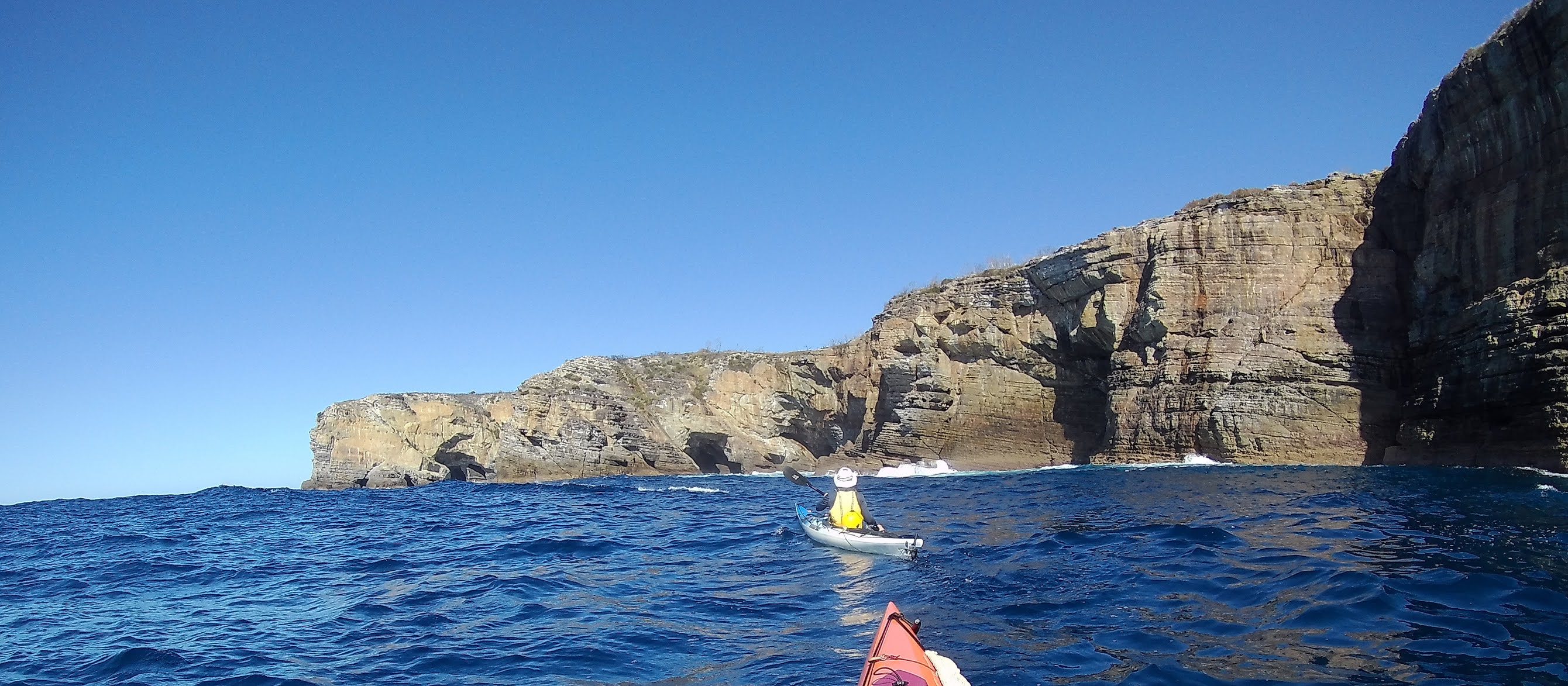
It was as spectacular as I expected
with big sandstone cliffs off-set by incredibly clear turquoise
water. We had a look at some big caves near Devils Elbow before
paddling back into the wind to the northern end of the island and
around to Murrays Beach. It would have been nice to paddle all the
way south to Steamers Beach but even I, who enjoys paddling into the
wind, thought that was pushing commitment too far. A battle with a
headwind across an otherwise sheltered bay is a different proposition
to a long haul up an exposed cliff lined coastline with no prospect
of landing.

On Murrays Beach, the talk was all
about what to do with the rest of the day. It was only around 11 am
so in my mind at least, way too early to head back on such a glorious
day. I was happy enough to go along with what other people wanted
to do as my goal of seeing the east side of Bowen Island had been
achieved. We seemed to decide to paddle around the south side of
Jervis Bay, possibly as far as Plantation Point where we would have a
shorter beam on crossing back to Honeymoon Bay.
Off we went, some paddling along the
shore, some straight-lining it between points. The beaches are
pretty, fairly empty, and there are some sandstone outcrops but,
after the splendour of the outer coast it all feels a bit tame.
Somewhere near Captains Beach and the Naval College I was beginning
to feel that lunch should be taken. It had been a long while since
breakfast.
Very abruptly, R and N decided they
were going back to Honeymoon Bay now, right now. The rest of us were
surprised. It was only about noon, it was unlikely the wind would
get any stronger, and, we were in a position around the Bay where we
would have the longest crossing directly into the northeasterly wind.
I was quite happy to do the paddle, but did want a break before what
could turn out to be a three hour crossing.
The rest of us landed and sought
shelter from the wind behind some sand dunes for lunch, and, more
important for me, a cup of tea. We were all a bit gob-smacked by the
quick, and I thought, rash, decision to head back without any rest,
food or water. Although, R and N had assured us they had food handy
in their boats, I could not see how they could stop to eat without
getting blown backwards, and, it was only midday.
In hindsight, I don't think we should
have let them go alone. But, it was a tricky situation. None of us
had eaten since breakfast many hours ago, and we all needed a leg
stretch, food and water before the paddle back. R, however, could
not be convinced to take even the shortest break and, if we had all
paddled off impetuously perhaps more of us would have got into
difficulty.
But, I am getting ahead of the story.
After our lunch, we plotted a route back that would have us paddling
pretty much due northeast into the wind, aiming to arrive on the far
shore perhaps a kilometre from Honeymoon Bay. If we paddled directly
into the wind we would not have to worry about working out how far we
were being blown off course and, aiming off to get a beam wind was
not really an option.

And, it was just a steady pull into the
wind. A and N were far faster than Doug and I, but I just focused on
keeping a good stroke and plugging on. In this kind of moderate
headwind, I find the paddle is more a mental than a physical game as
you can start to feel that you are making no progress at all.
However, as with most things in life, consistency is key, and slowly
we were half way, then two thirds, and finally the last few hundred
metres into shore. The last bit was easy because, even though we
were still into the wind, there was no wind chop just flat water and
something to look at and measure progress.
When we got back, we expected to find
the other two enjoying afternoon tea and were dismayed to find that
they had not yet got back to camp. Apparently, they had made it to
Silica Cove, about three kilometres south of Honeymoon Bay and had
landed there. They planned to leave their boats overnight and walk
back. A whole crew of people, including a couple of strong paddlers,
offered to walk down and retrieve their boats, as I would have done,
but R and N refused and arrived back at camp looking a wee bit
shattered about an hour later.
Not a bad outcome, but also not a great
outcome. I think it always wise to have a little bit of mojo left in
the tank so that you are not completely flogged at the denouement of
your adventure. Had the distance been a bit further or the wind and
chop a bit bigger and stronger, the situation might have been a bit
more perilous.
After the event, when I had time to
think about it, I realised that I had been one of the "people
with agendas." When I used to lead mountaineering trips back in Canada, I was always leery of the people with
agendas who signed up to join one of my trips. A friend of mine, who
used to guide professionally, had originally warned me about the
"people with agendas." In mountaineering circles, these
folks typically signed up for a trip not just to climb the mountain,
but also to prove they were faster, fitter, stronger, than other
people on the trip. People with agendas were often a bit of a
handful as their physical ability far outstripped their technical
skills and mountain savvy and, if they got to the front of the group,
they would lead the party into dangerous terrain.

My agenda was different. I am not the
fittest, fastest or strongest in my paddling circle and pretending
otherwise would be ludicrous. I am, however, determined to be fit
enough for my sports that I have a reasonable reserve left at the end
of every trip and I believe in doing uncomfortable things, like
paddling into the wind. So, my agenda was quite simply to paddle
into the wind in a relatively safe environment because paddling into
the wind is something we should all be doing regularly.